Thursday, 18 April 2013

Evaluation

In what ways does your media product use, develop or challenge forms and conventions of real media products?

For my film trailer(s), I created the fictional psychological thriller/found footage film “The Project”. The film is inspired by films of similar genres, “Chronicle” (Dir. Josh Trank, 2012, “The Blair Witch Project” (Dirs. Daniel Myrick & Eduardo Sánchez, 1999, US) and Paranormal Activity” (Dir. Oren Peli, 2007, US).


After viewing these trailers, I found that the trailers mostly contained elements of dialogue relative to the plot (without revealing spoilers), with title graphics: plot descriptions (One student.. one killer.. one chance), reviews ("Mindblowing!" Daily Paper) and major cast/crew appearances ("Starring Oscar winning actress..." "From the director of...."). Because a similar layout is conventional in most contemporary commercial films, I decided to style my trailer like this.


To keep my trailer short, but still entertaining, I decided to include a small a cast as I could, whilst also including the most mysterious lines of dialogue, as well as teasing the plot as much as I could, without ruining the ending.
How effective is the combination of your main product and ancillary texts?

For my ancillary texts, I styled both my magazine front cover and my film poster on conventional posters and magazine covers.
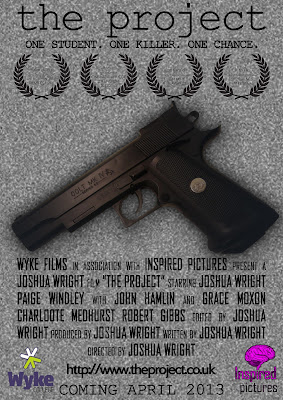
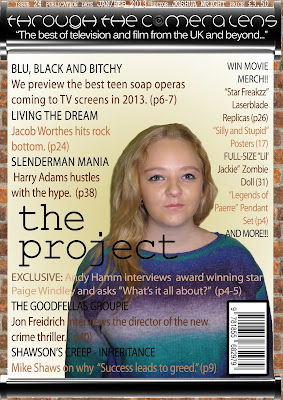

My magazine front cover includes a skyline, masthead, main image, barcode and cover lines, all styled in similar fonts and colours (apart from "the project", which is styled in the same font and colour as both the logo on the film poster and in the film trailer.) The style of the magazine cover is based on a brick wall/projection screen background, reinforcing the film subject.

The film poster includes the film logo at the top, along with the tagline seen in the trailer (ONE STUDENT. ONE KILLER. ONE CHANCE.), a film 'credit block' that appears on the majority of contemporary film posters, a background styled on the 'tv static' graphic that appears during the title graphics of the trailer.


What have you learnt from your audience feedback?

From my feedback, I learnt that my initial film magazine cover, based on the adult novel “Fifty Shades of Grey” had a layout and an overall look that was too similar to a film poster, and not a magazine cover. I took the advice and tips on board, and after a redesign of my magazine cover, I decided to rename the fictional magazine to "Through the Camera Lens", including a camera lens graphic in the first 'A' of camera.

How did you use new media technologies in the construction and research, planning and evaluation stages?


During pre-production, I used the social media websites Facebook and YouTube, to research and increase my knowledge of existing found footage/psychological thriller films, using websites like IMDB and the Guardian Film websites. I used these websites as Guardian Film and IMDB are both genuine sources of information on film, Facebook is readily available on my home computer, as well as my smartphone, and has lots of fan reactions of the films, and YouTube has a large amount of trailers and fan reviews.

During production, I decided to use my own camera. I did this because the camera had been bought previously because of this coursework, and it would mean the camera would be available more, rather than a shared college camera. I used my email program to contact my cast members to organise filming schedules. I also used Adobe Photoshop to create and begin editing my ancillary texts, because of the availability of the program both at home at at college, as well as because it has more effects and can edit more freely than programs like Paint, which is far too simplistic for the graphics I wished to produce.

During post-production, I used Adobe Premiere Pro to edit the main trailer, as well as continuing to use Photoshop for both my ancillary texts,as well as the graphics in the trailer. I also used the royalty-free audio library website freesound.org for the 'TV static' sound effects, and Adobe After Effects to create the 'TV static' graphic. I used Adobe Premiere Pro as it 
and can edit more freely than programs like Windows Movie Maker, which does not allow the user to edit in as much detail.

Thursday, 11 April 2013

NEW Film Magazine - Final


Because of my audience feedback, I have decided to make a new version:

  • Because the layout of "Fifty Shades of Film" was seen by some as looking more like a film poster than a magazine. Because of this, the magazine has a different font and colour design.
  • 'The Project' has been moved to the middle, to better simulate a film magazine front cover.
  • The main image has change from the gun to the Paige character, to be more in line with a generic magazine front cover.

Friday, 22 March 2013

Film Poster - FINAL Edit

This version has:

  • Tiny layout changes to provide text large enough to read, and enough spaces between items to clearly define between them.
  • I have also added the names of all of my cast, with the two main stars placed first, and my smaller parts placed last (in order: Joshua Wright, Paige Windley, (with) John Hamlin (and) Grace Moxon, Charlotte Medhurst Robert Gibbs)

Friday, 15 March 2013

Film Poster - Draft


This version of the film is a mixture of my two drafts, with the layout of the first version, and the content and images of the second version.

I prefer this version, as the 'static' background gives more depth than the plain black background, and the gun image is more prominent than the 'viewfinder' image. Overall, I preferred the layout of my first version (portrait) with the content of my second (gun/award wreaths), so I decided to merge them.

Thursday, 14 March 2013

Film Magazine - Final

I have made several changes:

  • Included magazine name and issue number on barcode
  • Cover lines redesigned to look more like a traditional magazine.
  • Selling line quote added below masthead.
  • Reorganised layout.
  • More textured background.

Monday, 11 March 2013

Film Magazine - Draft


This is a draft of the front cover of my film magazine, "Fifty Shades of Film". Designed to parody the popular adult book by E.L. James, Fifty Shades of Film features a similar colour, font and style layout to the front cover of Fifty Shades of Grey, with the image of a gun has replaced the image of the tie.

However, I have added some slight differences:

  • A skyline at the top of the cover, with the date of publication, issue no., editor name and price.
  • A barcode towards the bottom left.
  • A content block, similar to the 'film block' credits that appear on commercial film posters.
    • Instead of a production role in larger letters, with the name of the person in smaller letters, the content block has subheadings in larger letters, with content 'teasers' in smaller letters. I have also added an "ALSO:" line at the top.
There are still some changes I need to make. The layout of the barcode and the content block do not complement each other (the space between the barcode and content block is too small), and there is only one image (though I probably will not add others, the background of the cover does not look very appealing, due to the amount of space available.)

Film Poster v2 - Draft


Though similar to my previous draft, this poster has multiple differences:

  • Landscape image.
  • 'Gun' image instead of 'viewfinder screen' image
  • Four 'award wreaths' above the credit block
  • YouTube, Twitter, Facebook, BBFC Certificate and QR code have been removed.
  • Overall layout has changed.
I do not know, at this point, which image to choose as my final ancillary. Although this version does look 'busier' (ie has more content), I fear there may be too much content (another draft may be made.)

Friday, 8 February 2013

Film Poster - Draft


 This draft includes many conventions of a film poster, including

  • The title
  • Tagline of the film
  • Main image
  • Social networking links
  • A credit block
  • Production company logos
  • Age certificate
  • website link (I have also included a QR code for smartphone users)
  • Release date
The background image is the blurry grey static of a television, which links to the found footage style and television static transitions I will use in the film/film trailer

Monday, 3 December 2012

Rushes from 30/11/2012

Casting Issues

The main problem in a large filming project such as this is an organised and dependable cast.

I have a full cast of students, with one teacher, all playing roles in the film/film trailer similar to their real life roles.

However, sometimes you can't depend on everyone, due to unforeseen circumstances.

Last Friday, I organised a filming schedule with my media teacher, John, to film the scenes he is involved in.

However, due to certain issues, I could not film with him on that day. This has meant that I am behind schedule and I have missed my Monday deadline for the thirty second trailer.

Tuesday, 20 November 2012

Cast (so far)

Josh/The Murderer
played by Joshua Wright (myself)


Amy/Victim #1
played by Amy Black


Paige/Victim #2
played by Paige Windley


Callum/Victim #3
played by Callum Ahmed


Mr Hamlin/Victim #4
played by John Hamlin

Shot list (More pictures soon)

My full film has eleven scenes, shot in seven locations. Not all of these locations and not all of these scenes will be in the trailer, but I believe it is a good idea to record every scene and location that I MIGHT be placing in the trailer.

Scene A. INT IN. DARK ROOM – CAMERA POV
Scene B. INT IN. CLASSROOM #1 – AFTERNOON – CAMERA POV
Scene C. INT IN. DARK ROOM – CAMERA POV
Scene D. INT. OFFICE #2 – MORNING – CAMERA PO
Scene E. INT IN. DARK ROOM – CAMERA POV
Scene F. INT. OFFICE #2 – MORNING – CAMERA POV
Scene G. INT IN. BEDROOM – NIGHT – CAMERA POV
Scene H. INT IN. – STREET – AFTERNOON – CAMERA PO
Scene I. INT IN. CLASSROOM #2 – MORNING – CAMERA POV
Scene J. INT IN. REFECTORY – AFTERNOON – CAMERA POV
Scene K. INT IN. CORRIDOR – AFTERNOON – CAMERA POV

Location 1. Dark Room
(Scenes A, C, E, H1,)
This location will be where the murders take place, so I need a well-lit but empty room. Scene H1 does not currently exist in the script, but may need to be added to the film later, for narrative reasons. I have used Wyke's Green Screen Room, as it is a freely available. I can have control of any set or props that are used in this room, and in post-production, I can place a 'sepia' tone on the shot to turn the green into a more realistic orange/brown colour, or any other colour which looks ideal in the edit.


Location 2. Classroom #1/#2
(Scene B, I)
These may be two different Film/Media classrooms, or the same classroom, depending on the availability of rooms, and my personal choice.

Location 3. Office
(Scene D)
This scene will be filmed, due to the availability of the room and the current look of the room, in the current Media/Film office.

Location 4. Street
(Scene H)
This scene only has one character in, and is a generic street. I may use the outside of college as a substitute.

Location 5. Bedroom
(Scene G)
Only one scene will be scene in the Bedroom location, with only one character. As it is my character in the scene, and my character’s bedroom, I have decided to use my bedroom.

Location 6. Refectory
(Scene J)
This scene is the scene with the majority of main cast and extras in a single scene. Due to the availability and access, I will use my origingal idea and film in the college Refectory.

Location 7. Stairs/Corridor
(Scene K)
A continuing shot from Scene J, this will be shot on the staircase/corridor between the Refectory location of in Scene J and the Classroom(s)/Office locations of Scenes 2 and 3.


Monday, 19 November 2012

Codes and Conventions of my Chosen Genres

Psychological Horror
The psychological horror genre is a mix of the genres of horror and psychological thriller. Psychological horrors, like all horrors, concentrate on the antagonist(s) harming the protagonist(s), with a particular focus on the characters’ fears and emotions, and how the antagonist creates and/or manipulates these to create the horror element. A major aspect of psychological horror is that the identity of the antagonist can be kept a secret
As with horror, psychological horror will add canted/Dutch angles, to give a sense of disorientation for the audience, reflecting the characters’ emotions. Mirrors can be used to show the ‘two-faced/dark side’ aspects of characters (particularly if the audience are not fully aware of which character the antagonist is).
Mise-en-scene is very important in psychological horrors. Colour can be used to reflect the characters and their emotions, as well as giving very contrasting views. For example, two colours that are associated with psychological horrors are red and black. In a horror, black can mean death or mystery (if a character is in a dark location, there can be an element of mystery to their identity), and red can mean blood; however, in another genre, e.g. romance, red can mean passion and love. So although colour can be used, it has to be supported by other stylistics.
Fast editing will be used, in order to reflect heightened emotions of the characters.

Found Footage
Found footage is a genre of film in which all, or the majority, of the film is presented in either a ‘home video’ style, or a ‘lost footage’ documentary, left behind by the deceased protagonists (the latter more popular in horror/found footage hybrids, such as the popular films The Blair Witch Project [1999, Directed by Daniel Myrick & Eduardo Sánchez, US] and Paranormal Activity [2007; Directed by Oren Pele, US]. In found footage films, the filming is done by the actors themselves, and the camera is viewed as a prop in the film. This means the audience can have a direct link to the characters.
Cinematography is an incredibly important aspect of the found footage genre. There is usually only one camera throughout the entire film, which is used to document events. For example, in “Paranormal Activity”, the camera(s) are used to capture footage of the poltergeists, in “The Blair Witch Project” the single camera is used to document the students attempting to find the truth about the titular Blair Witch phenomena. Found footage films will often use close-ups to show the emotion of the characters.
Due to the minimal use of camera angles, one scene will be entirely shot in one take. Editing techniques (such as shot reverse shot, match on action) are completely ignored, and scene cuts are shown as a literal ‘cut’ of the camera.

No film soundtrack or score are usually used in found footage films, as all aspects of found footage are portrayed as being a part of the diegesis. This means that any emotion that the audience can draw from music (the ‘stabbing’ music in the psychological horror film Psycho) has to come from the cinematography and the performance of the actors. However, some aspects of sound can be predominant in both psychological horrors and found footage, such as the heartbeats of the characters, to reflect the emotion of the scene.


Film Trailers

Film trailers play a vital role on the marketing and promotion of a commercial film, by showing the significant moments, introducing the main characters and settings, with a teaser of the quest and/or disruption, along with fast editing, dramatic music and emotional, enthusiastic commentary (depending on the genre).
It is important in editing film trailers, to tease the contents of a film, and show the best and most enticing parts of a film, but not to show every exciting moment, there is still an attraction to see the entire film, to see the exciting parts hidden from the audience in the trailer.